
Pastor's letter for this week
October 23, 2026
Dear Parishioners of St. Andrew,
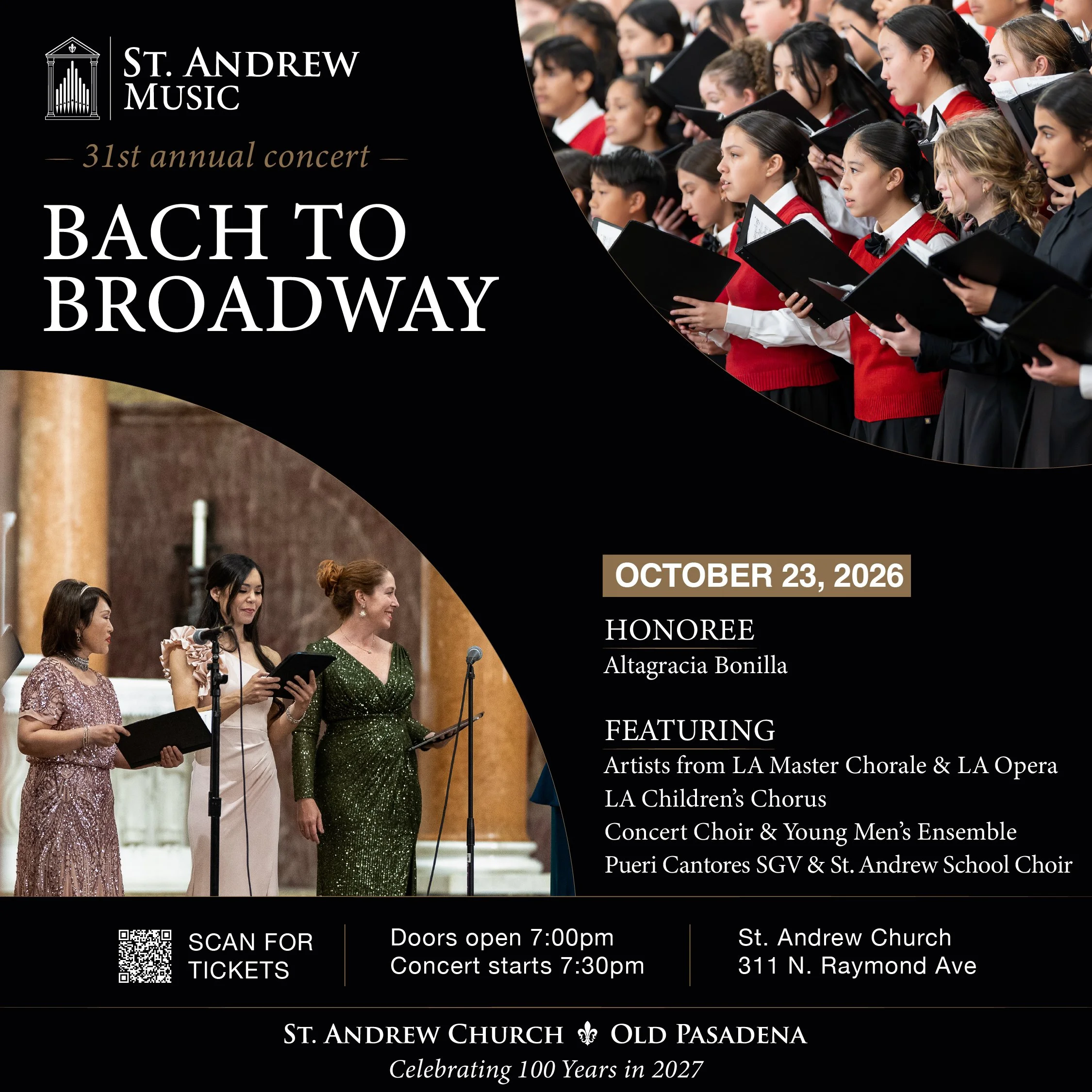
I hope you are all doing well and staying strong! It’s a busy and exciting day here at the parish today as we prepare for one of the biggest events of the parish year: the annual Bach to Broadway concert tonight. Please see the info below. It’s not too late to purchase your tickets! I hope to see you tonight.
This week our Archbishop, Most Rev. José H. Gomez, issued a beautiful pastoral letter which I strongly recommend for your reading. Here is the link:
https://lacatholics.org/wonder-of-america/
It is not yet available in Spanish so I will have that for our Spanish-speaking parishioners next week.
Here is the rest of the news from the parish:
IT’S TONIGHT! - OUR ANNUAL BACH TO BROADWAY CONCERT! – Our parish’s annual “Bach to Broadway” has finally arrived! It is tonight, Friday, October 23rd at 7:30 p.m. with doors opening at 7:00 p.m. It is my hope that we have a sold-out concert.
As you know, the proceeds from the concert go to the restoration efforts of our church. That funding is greatly needed as our church building continues to age yet must constantly be maintained and beautified. The Restoration Committee is working hard to ensure that the church is in beautiful condition for the Centennial next year. Tickets are on sale right now on our website: www.standrewpasadena.org.
There will be a beautiful reception for patrons in the piazza ahead of time and a dessert reception for everyone afterwards on Raymond Avenue. The details are on the website. I hope to see you all there!
Please note that there will be NO Spanish Mass OR evening Confessions tonight.
SPECIAL WORKSHOP FOR THE WOMEN OF THE PARISH – On Tuesday, November 3rd we are hosting a special evening workshop for all women of our parish (married, single or engaged) at 6:30 p.m. in the Parish Hall (school auditorium). It is about intimacy skills and is aimed at building a better and stronger marriage. Please see the flyer on the last page of this week’s bulletin.
ALL SAINTS DAY- This beautiful Solemnity which celebrates the Church Triumphant in heaven with all those holy ones who came before us, famous as well as the unknown, is celebrated next Sunday, November 1st. Since it falls on a Sunday this year it will be celebrated at all our Sunday Masses.
ALL SOULS DAY – Monday, November 2nd is the Commemoration of All Souls. We affirm our belief in the reality of sin as an offense against the awesome majesty of Almighty God, and in His just punishments. We affirm as well our belief that prayer is a powerful instrument before God's throne, that by it we are able to intercede for our deceased brothers and sisters.
As is our custom, we will pray especially for all those who died in our parish this past year. If you had a family member who passed away this year and the funeral was held here, then that person will be automatically on the list. If the funeral was held elsewhere and you’d like to include them in our prayer, please call the Pastoral Center at (626) 792-4183.
Our special annual Requiem Mass with the beautiful music of Gabriel Fauré will take place at 7:00 p.m. and all those who had a death in their family this last year will receive a special invitation. I highly recommend coming to this beautiful Mass which will be celebrated solemnly.
November 2nd also begins our All Souls Novena so now is the time to begin to enroll your deceased loved ones in the Novena of Masses which will begin on November 3rd and continue for 9 days. The envelopes are available in the Pastoral Center and also in the church gift shop.
GROUP WEDDING INFORMATION – Last Monday I had an information meeting for couples who are already civilly married or living together without marriage and need to receive the Sacrament of Holy Matrimony. Information and applications were given out. However, it is not too late to register. You may do so by stopping by the Pastoral Center to receive information and complete an application.
PRAY THE ROSARY! – During this month of the Holy Rosary it is especially worthwhile to pray the rosary as a family each day or at least a few times a week. Particularly during this month of Respect Life, please pray for our elected representatives. May they always govern with a concern for the common good of all and especially the most vulnerable of our society, the unborn.
RESPECT LIFE MONTH – October is also designated by the American Bishops as Respect Life Month. There are flyers by the doors of the church which will help all of us to do more to foster the respect of all human life from the moment of conception to natural death. There is also further information in all the bulletins this month as well as links to pro-life resources. Since it is also the month of the Holy Rosary, I especially recommend praying at least a decade of your daily rosary for an end to abortion in our land.
PLEASE ALSO NOTE THAT DAYLIGHT SAVINGS TIME ENDS NEXT SATURDAY NIGHT (Oct. 31) WHICH MEANS THAT WE "FALL BACK" AND GAIN AN HOUR. BE SURE TO CHANGE YOUR CLOCKS SO YOU ARE ON TIME FOR MASS!
In Christ and St. Andrew,
Fr. Gonzalez
EUCHARISTIC CONCOMITANCE
ETIQUETTE AND MANNERS IN CHURCH
HOW TO RECITE THE HOLY ROSARY
PROCEDURE FOR THE RECEPTION OF HOLY COMMUNION